Crochet Abbreviations (US vs UK): Complete Beginner Guide
Crochet patterns often use abbreviations to make instructions shorter and easier to follow. For beginners, however, these abbreviations can sometimes feel confusing at first.
If you have ever opened a crochet pattern and seen instructions like dc, hdc, sl st, ch, or sc, you might have wondered what they mean.
These shortened terms are called crochet abbreviations, and they are used in almost every crochet pattern. Learning them is one of the most important steps in becoming comfortable reading crochet instructions.
Crochet abbreviations help designers write patterns clearly while keeping the instructions compact and easy to repeat. Once you understand the most common abbreviations, you will find that crochet patterns become much easier to follow.
In this guide, you will learn:
• what crochet abbreviations are
• the most common crochet abbreviations used in patterns
• the difference between US and UK crochet terminology
• how to read crochet patterns using abbreviations
• tips for remembering crochet abbreviations
By the end of this guide, you will feel much more confident reading crochet patterns and understanding common crochet instructions.
What Are Crochet Abbreviations?
Crochet abbreviations are shortened versions of crochet terms used in patterns and tutorials.
Instead of writing the full name of every stitch repeatedly, designers use abbreviations to make instructions easier to read and repeat.
For example:
• ch means chain
• sc means single crochet
• dc means double crochet
• sl st means slip stitch
Using abbreviations allows crochet patterns to stay organized and easy to follow, especially when instructions repeat many times.
Once you learn the most common crochet abbreviations, reading patterns becomes much faster and more intuitive.
Why Crochet Abbreviations Are Important
Crochet abbreviations play a crucial role in making crochet patterns easier to read and follow. Without abbreviations, patterns would become extremely long and repetitive, especially for projects that contain many rows or rounds.
Imagine reading a blanket pattern where the full name of each stitch is written repeatedly. Instead of writing “double crochet” hundreds of times, designers simply write dc. This small change makes patterns much more compact and readable.
Abbreviations also allow crocheters to quickly recognize familiar instructions. Once you become familiar with common crochet abbreviations, you will be able to scan patterns more quickly and understand instructions at a glance.
Another advantage of crochet abbreviations is that they create a universal system used by crochet designers around the world. Even though patterns may vary in style, most of them rely on a shared set of abbreviations that crocheters recognize.
For beginners, learning crochet abbreviations may feel overwhelming at first. However, most crocheters find that they memorize the most common abbreviations after completing only a few projects.
Why Crochet Patterns Use Abbreviations
Crochet patterns often include many repeated instructions. Without abbreviations, patterns would become extremely long and difficult to read.
For example, imagine writing a blanket pattern that repeats the phrase double crochet hundreds of times. Using the abbreviation dc makes the pattern easier to follow and reduces visual clutter.
Abbreviations also help crocheters recognize familiar instructions quickly. After practicing for a while, most crocheters can instantly recognize common abbreviations without needing to think about them.
Because of this, crochet abbreviations have become a standard part of crochet pattern writing around the world.
Most Common Crochet Abbreviations
In addition to the basic crochet abbreviations used in beginner patterns, there are many other abbreviations that appear in more advanced crochet projects.
Below is an extended list of crochet abbreviations you may encounter when reading patterns.
| Abbreviation | Meaning |
|---|---|
| ch | chain |
| sc | single crochet |
| hdc | half double crochet |
| dc | double crochet |
| sl st | slip stitch |
| st | stitch |
| sts | stitches |
| rep | repeat |
| sk | skip |
| sp | space |
| yo | yarn over |
| inc | increase |
| dec | decrease |
| blo | back loop only |
| flo | front loop only |
| rnd | round |
| row | row |
| beg | beginning |
| tog | together |
| pm | place marker |
When learning crochet abbreviations, beginners often feel overwhelmed by the number of terms used in patterns. However, the good news is that most beginner crochet patterns use only a small group of abbreviations.
Once you understand the most common ones, reading crochet instructions becomes much easier.
For example, abbreviations like ch (chain), sc (single crochet), hdc (half double crochet), and dc (double crochet) appear in thousands of crochet patterns. These stitches form the foundation of many beginner and intermediate projects.
The abbreviation sl st, which stands for slip stitch, is also extremely common. This stitch is often used to join rounds or finish edges neatly.
Another abbreviation you will frequently see is yo, which means yarn over. This instruction appears in many crochet stitches and indicates that the yarn should be wrapped around the hook before pulling through loops.
By becoming familiar with these abbreviations, beginners can quickly gain confidence when reading crochet patterns.
With a little practice, most crocheters find that they begin to recognize these abbreviations automatically while working on projects.
Printable Crochet Abbreviations Chart
If you prefer a quick reference while crocheting, a printable crochet abbreviations chart can be extremely helpful.
Many crocheters like to keep a small abbreviations guide nearby when working on projects. This makes it easy to quickly check unfamiliar terms without interrupting your workflow.
Below you can download or save a printable crochet abbreviations chart that includes many of the most common crochet terms used in patterns.
You can print it and keep it in your crochet bag, pattern binder, or craft area so it is always available when you need it.
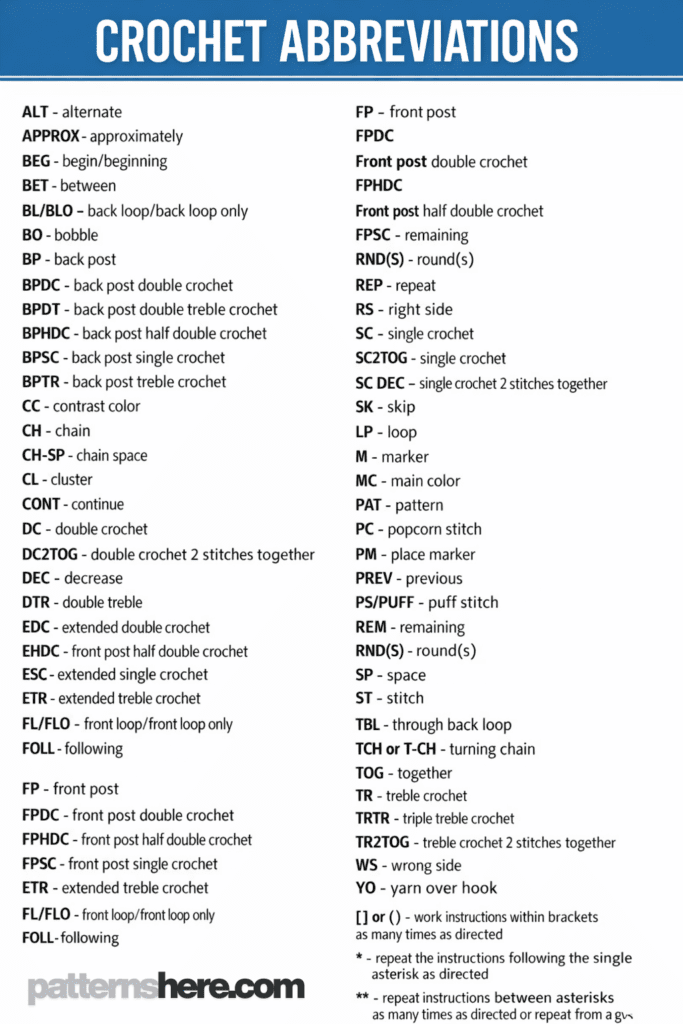
Tip: Many crocheters also save this chart on their phone or tablet so they can quickly reference crochet abbreviations while following digital patterns.
US vs UK Crochet Abbreviations
One of the most confusing aspects of crochet abbreviations is that US and UK crochet terminology use different names for the same stitches.
If you follow a pattern written in UK terminology, the stitch names will be different even though the crochet technique may be the same.
Below is a helpful comparison chart.
| US Term | UK Term |
|---|---|
| single crochet (sc) | double crochet |
| half double crochet (hdc) | half treble crochet |
| double crochet (dc) | treble crochet |
| treble crochet | double treble crochet |
Because of this difference, it is very important to check whether a crochet pattern uses US or UK terminology before starting your project.
Most crochet patterns will specify this at the beginning.
Why US and UK Crochet Terms Are Different
One of the most confusing aspects of crochet abbreviations is the difference between US and UK crochet terminology.
These differences developed historically as crochet patterns spread across different regions. Designers in the United States and the United Kingdom used slightly different naming systems for crochet stitches.
As crochet patterns became more widely published in magazines and books during the 19th and early 20th centuries, these naming differences became standardized within each region.
Today, most crochet patterns clearly specify whether they use US terms or UK terms. Checking this information before starting a project is very important because using the wrong terminology can completely change the appearance of the stitches.
For example, a stitch called double crochet in the US is actually called treble crochet in the UK. If you accidentally follow the wrong terminology, the height of your stitches may not match the pattern instructions.
Because of this, many crochet designers now include a terminology note at the beginning of their patterns to avoid confusion.
How to Read Crochet Abbreviations in Patterns
When reading crochet patterns, abbreviations are usually combined with numbers and symbols to describe the sequence of stitches.
For example:
ch 2, dc in next st, rep across row
This instruction means:
• chain two
• make a double crochet in the next stitch
• repeat the instruction across the row
Parentheses and brackets are often used to indicate repeated sections of stitches.
Example:
( dc, ch 1 ) rep 5 times
This means you repeat the sequence double crochet, chain one five times.
Understanding these patterns becomes much easier once you recognize the abbreviations.
Understanding Crochet Pattern Symbols
In addition to abbreviations, many crochet patterns also use symbols and punctuation to explain how stitches should be repeated.
For example, parentheses are commonly used to indicate a group of stitches that should be repeated.
Example:
(dc, ch 1) rep 6 times
This instruction means that the sequence double crochet, chain one should be repeated six times.
Brackets and asterisks are also frequently used in crochet patterns.
Example:
*sc, ch 1* rep across row
This means that the sequence between the asterisks should be repeated across the entire row.
Understanding these symbols makes it much easier to follow crochet patterns, especially those that contain repeated stitch sequences.
How to Remember Crochet Abbreviations
Learning crochet abbreviations may feel overwhelming at first, but most beginners quickly memorize the most common ones.
Here are a few tips that can help.
Practice With Simple Patterns
Beginner patterns often repeat the same abbreviations multiple times. Practicing with simple patterns helps reinforce the meanings of each abbreviation.
Keep a Reference Chart
Many crocheters keep a crochet abbreviations chart nearby while working on projects. After a while, you will find that you no longer need to check it frequently.
Learn the Most Common Stitches First
Stitches such as single crochet, half double crochet, double crochet, and slip stitch appear in many patterns. Once you learn these stitches and their abbreviations, reading patterns becomes much easier.
Practice Makes Crochet Abbreviations Easier
Like many crochet skills, learning abbreviations becomes easier with practice. The more patterns you read and follow, the more familiar these terms will become.
Many crocheters notice that after completing just a few projects, they no longer need to check abbreviation charts frequently. The most common terms quickly become second nature.
A helpful way to practice is by following beginner tutorials that use basic stitches such as double crochet, half double crochet, and slip stitch. Because these stitches appear in many patterns, their abbreviations are repeated frequently.
Another effective method is to keep a small notebook or digital list of abbreviations while working on projects. Writing them down can help reinforce memory and make them easier to recall later.
Over time, reading crochet patterns will begin to feel natural and intuitive.
Tips for Learning Crochet Abbreviations Faster
For beginners, learning crochet abbreviations may feel intimidating at first. However, there are several simple strategies that can help you learn them more quickly.
Practice With Beginner Patterns
Beginner patterns often use only a small number of abbreviations. Working through simple projects allows you to repeatedly see the same abbreviations until they become familiar.
Keep a Crochet Reference Sheet
Many crocheters keep a printed abbreviations chart nearby while working on projects. This makes it easy to check unfamiliar abbreviations without interrupting your workflow.
Watch Crochet Tutorials
Video tutorials can also help beginners understand how crochet abbreviations translate into real stitches.
Seeing the stitches in action makes it easier to remember their meanings.
Start With the Most Common Stitches
Focusing on the most common crochet stitches first will help you learn abbreviations faster.
These include:
• chain (ch)
• single crochet (sc)
• half double crochet (hdc)
• double crochet (dc)
• slip stitch (sl st)
Once you become comfortable with these abbreviations, many crochet patterns will start to feel much easier to read.
How Designers Use Crochet Abbreviations in Patterns
Crochet designers rely on abbreviations to keep patterns organized and easy to follow. Because many crochet patterns include repeated stitch sequences, abbreviations help reduce the length of instructions while still keeping them clear.
For example, a pattern may repeat a sequence such as double crochet, chain one, skip one stitch many times across a row. Instead of writing the full instructions each time, the designer can shorten them using abbreviations.
This allows patterns to remain compact while still providing detailed instructions.
Designers also use abbreviations to make patterns easier to translate into different languages. Because many crochet abbreviations are standardized, crocheters around the world can follow patterns more easily.
For beginners, understanding how designers use abbreviations can make patterns feel much less intimidating.
Video Tutorial: Understanding Crochet Abbreviations
If you prefer visual explanations, watching a crochet tutorial can help clarify how abbreviations appear in real patterns.
Many beginner crochet videos explain how abbreviations are used within pattern instructions, which can make learning them easier.
Common Mistakes Beginners Make
When learning crochet abbreviations, beginners sometimes make a few common mistakes.
Confusing US and UK Terminology
Always check whether the pattern uses US or UK terminology before starting.
Skipping Pattern Notes
Many patterns include a section explaining the abbreviations used. Skipping this section can lead to confusion later.
Misreading Repeats
Pay attention to parentheses and instructions that indicate repeated stitches.
Taking a moment to carefully read each instruction can help avoid mistakes.
Crochet Tools That Help Beginners
If you are learning how to read crochet patterns, having the right tools can make the process easier.
Many beginners find it helpful to use:
• ergonomic crochet hooks
• medium weight yarn
• stitch markers
• yarn needles
These tools make crochet projects easier to manage and more comfortable to complete.
How Crochet Abbreviations Appear in Real Patterns
Understanding crochet abbreviations becomes easier when you see them used in actual pattern instructions.
Here is an example of a simple crochet instruction using abbreviations.
ch 20
Row 1: sc in 2nd ch from hook, sc across row
Row 2: ch 1, sc across row
When written in full words, this instruction would read:
Chain twenty.
Single crochet in the second chain from the hook, then single crochet across the row.
Chain one, then single crochet across the row.
Using abbreviations allows the pattern to remain compact while still providing clear instructions.
As you continue crocheting, these abbreviated instructions will quickly become familiar.
Crochet Abbreviations in Beginner Patterns
Most beginner crochet patterns rely on a small group of abbreviations. Learning these abbreviations early makes it much easier to start new crochet projects.
Some of the most frequently used abbreviations in beginner patterns include:
• ch – chain
• sc – single crochet
• hdc – half double crochet
• dc – double crochet
• sl st – slip stitch
These stitches appear in many beginner-friendly projects such as scarves, dishcloths, blankets, and granny squares.
Because these stitches are so common, many crochet tutorials focus on teaching them first. Once beginners feel comfortable with these basic abbreviations, they can begin exploring more advanced crochet patterns.
Mastering these abbreviations is an important step toward becoming a confident crocheter.
FAQs
What does ch mean in crochet?
In crochet patterns, ch stands for chain.
What does sc mean in crochet?
sc means single crochet in US crochet terminology.
What does dc mean in crochet?
dc stands for double crochet stitch.
What does sl st mean in crochet?
sl st means slip stitch.
Do all crochet patterns use abbreviations?
Most crochet patterns use abbreviations to simplify instructions and make patterns easier to read. These abbreviations are widely recognized by crocheters and are considered a standard part of crochet pattern writing.
See Also
If you are learning crochet basics, these guides from Patterns Here can help:
How to Double Crochet Stitch (dc): Easy Step-by-Step Tutorial for Beginners
How to Half Double Crochet Stitch (hdc): Easy Step-by-Step Tutorial for Beginners
Slip Stitch Crochet (sl st): Easy Step-by-Step Tutorial for Beginners
🧶 Magic Circle Crochet (Magic Ring) – Easy Step-by-Step Guide
Crochet Hook Size Chart (US & Metric) + Yarn Weight Guide
Conclusion
Crochet abbreviations are an essential part of reading crochet patterns. While they may seem confusing at first, most crocheters quickly become familiar with the most common terms.
By learning these abbreviations and practicing with beginner patterns, you will find that crochet instructions become much easier to follow.
As your skills grow, understanding crochet abbreviations will allow you to explore more complex patterns and creative projects.